Steam desuperheater valves — also known as attemperators or steam conditioning valves — are used across power plants and process industries to bring superheated steam down toward its saturation temperature before it reaches downstream equipment. Freture Techno manufactures DSH valves and desuperheating assemblies for boiler steam temperature control, turbine bypass systems, and process steam conditioning applications. This guide covers how a steam desuperheater works, the main valve types, key selection parameters, and the standards that govern their design.
Table of Contents
- What Is a Steam Desuperheater (DSH) Valve?
- How a Desuperheater Works
- Types of Steam Desuperheater Valves
- Key Components of a DSH Assembly
- Desuperheater vs. PRDS
- Selection Parameters
- Applications & Industries
- Standards & Compliance
- Installation & Maintenance
- FAQs
1. What Is a Steam Desuperheater (DSH) Valve?
A steam desuperheater (DSH) valve is a control device that reduces the temperature of superheated steam by injecting a controlled spray of water directly into the steam flow. As the water droplets absorb heat and evaporate, the steam cools toward its saturation temperature — a process known as desuperheating or attemperation. The DSH valve, sometimes paired with a separate spray water control valve, meters exactly how much water is injected based on a downstream temperature signal, keeping steam conditions within the tight tolerances that turbines, process equipment, and piping systems require.
2. How a Desuperheater Works
A temperature control loop drives the entire process. A temperature sensor downstream of the desuperheater continuously measures steam temperature and sends a signal to a controller, which compares it against the setpoint. The controller then sends a proportional signal to the water control valve (also called a temperature control valve or TCV), which opens or closes to regulate the quantity of atomized water sprayed through the nozzle. As the water contacts the superheated steam, evaporative cooling draws heat from the steam itself, lowering its temperature. The success of this process depends on nozzle design, steam velocity, water droplet size, and the absorption length available downstream for full evaporation before the steam reaches the next elbow, instrument, or piece of equipment.
3. Types of Steam Desuperheater Valves
Different plant conditions call for different desuperheater designs. The main types include:
Single-Point (Radial Injection) Spray Desuperheater A single spray nozzle is introduced through the pipe wall, injecting water radially across the steam flow. This is the simplest and most cost-effective design, with minimum pressure drop, but it has a low turndown ratio (typically around 3:1) and can only cool steam to within about 10°C of saturation temperature. It suits applications with constant steam load, temperature, and coolant temperature.
Multi-Nozzle Axial Injection Desuperheater Instead of one nozzle, several nozzles are arranged across the flow for better water dispersion. This category splits into two designs:
- Fixed area type — all nozzles remain open during operation, with cooling water flow regulated entirely by the spray water control valve.
- Variable spray type — the number of active nozzles changes with demand; as downstream temperature rises, the actuator progressively exposes more nozzles for finer control across a wider turndown range.
Venturi / Ejector Type Desuperheater This design uses the kinetic energy of high-velocity steam through a tapered venturi throat to atomize the cooling water, rather than relying solely on nozzle pressure. Ejector-type desuperheaters can achieve high turndown ratios — up to 40:1 in some designs — making them well suited to variable-load power plant and turbine bypass applications.
Integral vs. Non-Integral Desuperheater An integral desuperheater combines the spray nozzle and control valve/actuator in a single unit, reducing installation complexity. A non-integral (or split) design uses a separate spray water control valve and desuperheater body, offering more flexibility in layout for larger or more complex steam systems.
Direct Contact vs. Indirect Desuperheater Most industrial DSH valves are direct-contact types, spraying water straight into the steam path for fast response to load changes. Indirect (non-contact) desuperheaters instead pass steam through a heat exchanger — commonly shell-and-tube — cooling it without physically mixing water and steam. Indirect types are generally less efficient due to lower heat transfer rates but are used where water quality or contamination concerns rule out direct injection.
4. Key Components of a DSH Assembly
- Spray nozzle(s) — atomize cooling water into fine droplets for rapid evaporation
- Water/temperature control valve (TCV) — regulates spray water flow based on the control signal
- Actuator — pneumatic or electric, driving the valve/nozzle assembly
- Temperature sensor and transmitter — measures downstream steam temperature for the control loop
- Thermal liner or sleeve — protects the pipe wall from thermal shock and erosion at the injection point
- Strainer — protects the spray water valve and nozzles from debris in the water supply
5. Desuperheater vs. PRDS
A Pressure Reducing and Desuperheating Station (PRDS) combines two functions in one skid: a pressure control valve (PCV) that reduces steam pressure to the required downstream level, and a desuperheater/TCV assembly that controls steam temperature. Where pressure reduction alone is required, only a PR skid is used; where temperature control alone is required, a standalone DSH Valve or desuperheating skid is used. Combined PRDS units are common in power plants for turbine bypass systems, auxiliary steam headers, and deaerator steam supply, since they save piping, space, and installation cost compared to two separate skids.
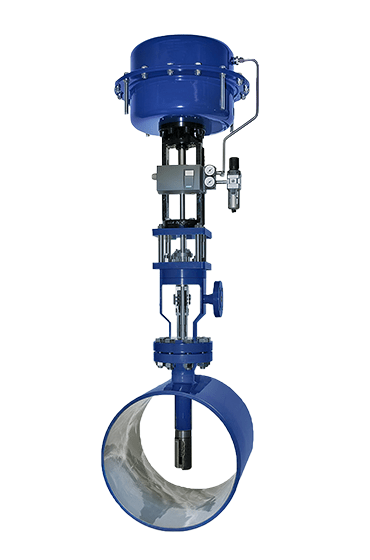 |
| Steam Desuperheater (DSH) Valve |
6. Selection Parameters
Choosing the right desuperheater valve depends on several operating parameters:
- Turndown ratio — the range between minimum and maximum controllable flow; variable spray and venturi types offer higher turndown than single-point designs
- Steam velocity and pipe size — minimum steam velocity is required for proper water atomization and absorption
- Pressure drop across the nozzle — affects atomization quality and system energy loss
- Absorption length — the straight pipe run downstream needed for complete water evaporation before reaching bends, instruments, or equipment
- Water quality — affects nozzle wear, fouling, and whether direct or indirect contact is appropriate
- Load variability — constant-load systems can use simpler single-point designs; variable-load systems benefit from multi-nozzle or venturi types
7. Applications & Industries
Steam desuperheater valves are used wherever superheated steam needs to be conditioned before use:
- Boiler steam temperature control in thermal and combined-cycle power plants
- Turbine bypass systems during startup, shutdown, or load-rejection events
- Heat Recovery Steam Generator (HRSG) steam conditioning
- Deaerator and ejector steam supply
- Process heating in sugar, textile, paper, and food processing plants
- Auxiliary steam systems: fuel oil atomization, steam tracing, soot blowing, turbine gland sealing
8. Standards & Compliance
Desuperheater valves and PRDS assemblies supplied for Indian power and process plants are commonly required to be IBR (Indian Boiler Regulations) certified, with pressure part fabrication and welding meeting IBR requirements. Pressure vessel components are often designed with reference to ASME Section VIII for construction, while valve pressure-temperature ratings generally follow ASME B16.34. Pressure classes for these assemblies commonly range up to ANSI 2500#, depending on plant steam parameters. Exact certification requirements should always be confirmed against the specific plant's boiler code and project specification.
9. Installation & Maintenance
Correct installation is critical to desuperheater performance. The unit should be located where sufficient straight pipe length is available downstream for water to fully evaporate before reaching a bend, control valve, or instrument — insufficient absorption length is a common cause of pipe erosion and wet steam carryover. Thermal liners should be specified wherever thermal cycling or erosion risk is high. During maintenance, nozzles should be inspected periodically for wear or fouling, and the spray water strainer should be checked and cleaned on a regular schedule to protect the control valve from debris.
10. FAQs
What is the difference between a desuperheater and an attemperator? The terms are used interchangeably in most of the industry — both describe equipment that reduces superheated steam temperature by water injection.
What turndown ratio should I expect from a DSH valve? It depends on the design: single-point radial injection types typically offer around 3:1, while multi-nozzle variable spray and venturi/ejector types can reach much higher ratios, in some cases up to 40:1.
Do desuperheater valves need IBR certification in India? Most power plant and process steam applications in India require IBR-certified pressure parts and welding for desuperheater and PRDS assemblies; requirements should be confirmed against the specific project scope.
Can a desuperheater cool steam all the way to saturation temperature? Simple single-point designs generally cannot reduce steam below about 10°C above saturation; multi-nozzle and venturi designs can typically get closer to saturation temperature under the right conditions.
Why Choose Freture Techno
Freture Techno designs and manufactures steam desuperheater valves and PRDS assemblies to the pressure class, turndown ratio, and certification requirements of power and process plants. From single-point spray desuperheaters to multi-nozzle and venturi designs, our engineering team specifies the right configuration for your steam conditions. Contact us to discuss your desuperheating or steam conditioning requirement.


No comments:
Post a Comment